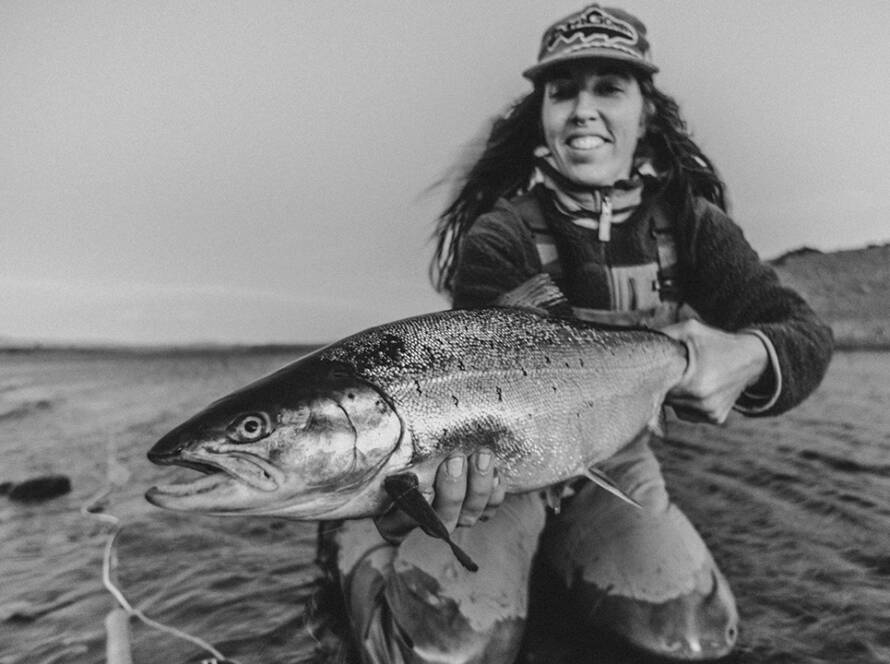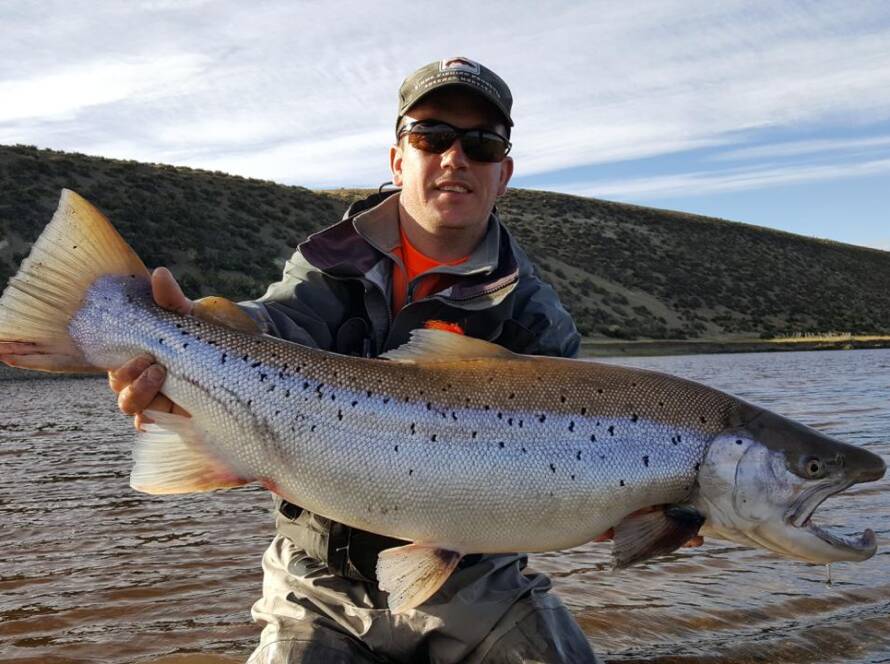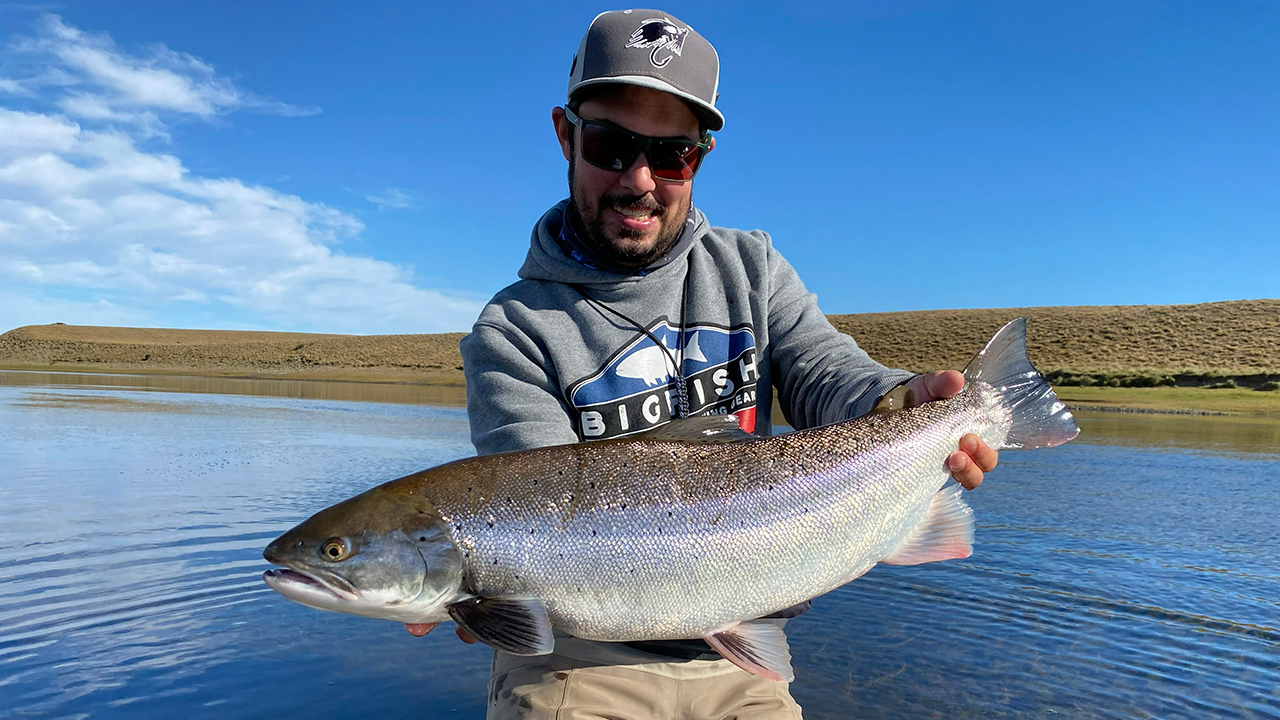
Some fish become legends.
Others become obsessions.
But very few become both.
The sea-run brown trout of Patagonia belongs to that rare category — a fish so powerful, so unpredictable, and so deeply connected to the wild rhythm of land and ocean that it lives in the imagination of anglers long before they ever set foot in Argentina.
Stories of these trout feel almost mythical:
A chrome flash in the low light.
A violent pull that comes without warning.
A run so strong it makes your reel scream and your chest tighten.
A fish that feels more like a force of nature than a creature.
Yet behind the mystery lies a story — a life cycle shaped by storms, tides, migration, survival, and instinct.
To understand these fish is to understand Patagonia itself: fierce, raw, and breathtakingly beautiful.
This article takes you deep into the biology, behavior, and magic of sea-run brown trout — the most iconic fish of southern Patagonia and the heart of rivers like the Río Gallegos, home of Karku Fly Fishing Lodge.
1. What Exactly Are Sea-Run Brown Trout?
Sea-run brown trout (Salmo trutta) are anadromous — meaning they spend part of their lives in freshwater and part in the ocean.
They are genetically identical to resident brown trout. What makes them different is choice.
In places like Patagonia, where nutrient levels in freshwater can be low, some juvenile browns will migrate to the sea to find more food.
There, they feast on:
crustaceans
small fish
marine invertebrates
This abundant diet allows them to grow exponentially larger than their freshwater relatives.
Then, driven by instinct, they return to the river of their birth — not to feed, but to spawn.
This journey makes them:
stronger
heavier
faster
more aggressive
more resilient
This is why hooking a sea-run brown feels like connecting to a living storm.
2. Why Patagonia Produces the World’s Best Sea-Runs
Sea-run browns exist in places like Scotland, Iceland, Norway, and the Pacific Northwest.
But nowhere do they reach the size, power, and abundance of those in Patagonia.
A Perfect Combination of Factors
1. The South Atlantic’s Rich Feeding Grounds
Cold, nutrient-dense waters lead to explosive growth.
A trout can go from two pounds to ten pounds in a single marine cycle.
2. Massive Migration Pathways
Rivers like the Río Gallegos and Río Grande have wide geographic mouths and direct access to deep ocean currents.
3. Minimal Predation
Few natural predators in the open sea allow sea-runs to mature safely.
4. Low Population Density
Patagonia’s remoteness means there’s little human interference and almost no industrial pollution.
5. Sustainable Fishing Culture
Catch-and-release, single-hooks, and private management protect the fishery.
The result?
A fish that routinely breaks the 10-pound mark.
A fish that can exceed 20 pounds.
A fish that seems carved from the wild.
3. The Life Cycle of a Sea-Run Brown Trout
Understanding their cycle makes you a better angler — and a better steward of the river.
Stage 1: Birth in Freshwater
Brown trout hatch in gravel beds (redds) in late spring and early summer.
They spend their early months feeding on insects and small invertebrates.
Stage 2: “The Decision”
At around 1–3 years old, some fish migrate to the ocean.
Scientists still don’t fully understand why some stay and others leave — it seems tied to:
food availability
genetics
water chemistry
This is one of nature’s great mysteries.
Stage 3: Transformation in the Ocean
Once at sea, their bodies change:
color fades to bright chrome
spots become faint
muscle density increases
stamina skyrockets
They become powerhouses.
Stage 4: Return to the River
When mature, they return to freshwater to spawn.
This is when anglers encounter them — thick-shouldered, silver, unstoppable.
Stage 5: After Spawning
Some die.
Some return to the sea and repeat the cycle, growing even larger.
This journey makes every encounter a miracle of biology and endurance.
4. Seasons and Behavior
Early Season (November–December)
Fresh sea-runs enter the river — bright chrome, aggressive, and incredibly strong.
Fishing is technical but rewarding.
Mid Season (January–February)
Fish spread throughout the system.
Evening fishing becomes exceptional.
Nymphs and leeches perform well.
Late Season (March–April)
The giants arrive.
This is trophy time — darker fish, massive shoulders, deep runs, unforgettable fights.
Behavior Patterns
Sea-run browns often hold in:
deep pools
undercut banks
oxygen-rich runs
areas with gravel transitions
Their feeding varies — in freshwater, they mostly react out of aggression, not hunger.
Fishing for them is psychological.
It’s about reading mood, speed, light, shadows, and timing.
5. How to Target Sea-Run Brown Trout Successfully
Gear That Matters
Rod: 7–8 weight single-hand or 11–12′ switch rod
Reel: strong drag, large arbor
Line: floating + sink tips (T8, T11)
Tippet: 0X–2X fluorocarbon
Flies They Love
The Patagonia classics:
Girdle Bug
Prince Nymph
Sunray Shadow
Egg-Sucking Leech
Small intruders
Timing Is Everything
Best fishing windows:
early morning low light
late evening into dusk
cloudy, windy days
falling barometer
Sea-runs move constantly.
Their mood changes with temperature, wind, and tide influence.
This is why local guides are priceless — they read conditions at a glance.
6. Why Sea-Run Browns Feel Different on the Line
There is no comparison.
When a sea-run brown picks up your fly, you feel:
an immediate surge of raw muscle
a powerful downstream charge
deep headshakes
long bursts of speed
unpredictable changes in direction
They use the river’s flow, their ocean-hardened conditioning, and their thick shoulders to fight in a way resident trout simply cannot match.
Landing one requires:
patience
strong gear
good footwork
steady control
a calm mind
Every battle is unforgettable.
7. Conservation: Protecting Patagonia’s Sea-Run Heritage
These fish survive because Patagonia has embraced a culture of respect:
strict catch-and-release
single hooks
minimal handling
limited angler pressure
Lodges like Karku Fly Fishing Lodge play a crucial role, offering controlled access to private sections of the river where fish are carefully protected.
Without this stewardship, the sea-run fishery would not exist as it does today.
8. Where to Experience Sea-Run Browns at Their Best
There are few rivers in the world where sea-runs reach legendary status.
At the top of that list:
1. Río Grande
The most famous — giant fish, harsh conditions, high demand.
2. Río Gallegos
More intimate.
More technical.
More poetic.
Less crowded.
This river rewards precision and patience.
Its low gradient, clear water, and meandering pools create the perfect environment for sea-run browns.
3. Río Santa Cruz
Wild, broad, and powerful, though more impacted by glacial influence.
For anglers seeking a blend of solitude, technical fishing, and spectacular fish — Río Gallegos is unmatched.
9. Karku Fly Fishing Lodge: A Place Made for Sea-Run Browns
Karku sits on the banks of the Río Gallegos with over 40 kilometers of private access and 40 named pools.
This is one of the most intimate and rewarding places to target sea-runs in Patagonia.
What makes it special:
Small groups (quiet water, rested pools)
Local guides who grew up here
Solar-powered lodge with low ecological impact
Authentic family-run atmosphere
Technical water that rewards anglers who love a challenge
Consistent encounters throughout the season
Karku doesn’t try to be the “biggest lodge” — it tries to be the most meaningful.
And for sea-run browns, meaning matters.
Action Sea-run brown trout are more than a species
They are symbols — of endurance, mystery, wilderness, and the ancient rhythm that connects river to ocean and back again.
To chase them is to step into a story older than any angler.
To hook one is to feel Patagonia’s pulse in your hands.
To release one is to honor the river, the land, and the future of this extraordinary fish.
If you dream of understanding — and experiencing — the magic of sea-run browns, there is no better place than southern Patagonia.
And if you want a lodge where authenticity, conservation, and local expertise come together, Karku Fly Fishing Lodge is one of the most soulful places you can cast a line.
👉 Experience the sea-run brown trout of Patagonia at Karku Fly Fishing Lodge
Contact Us