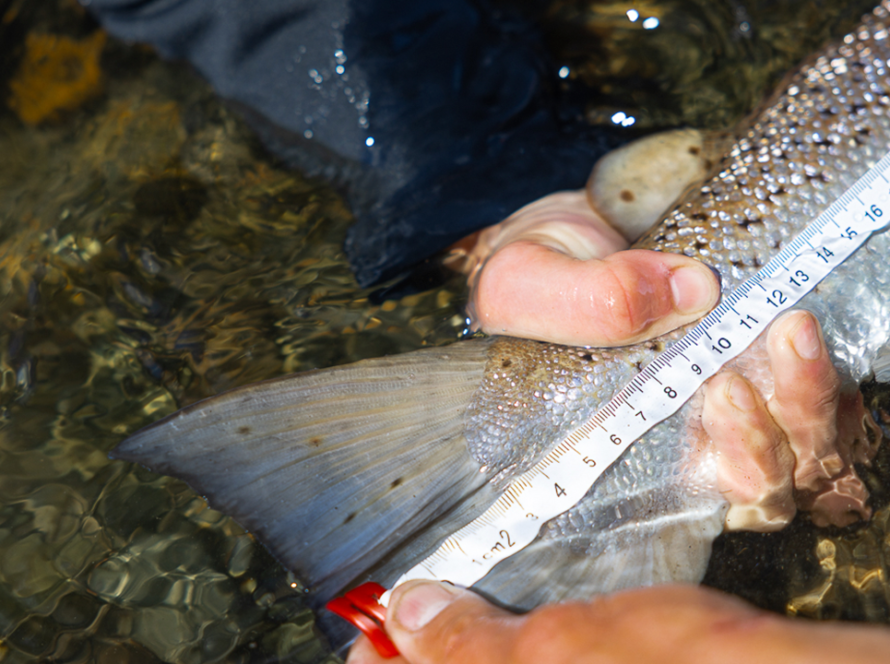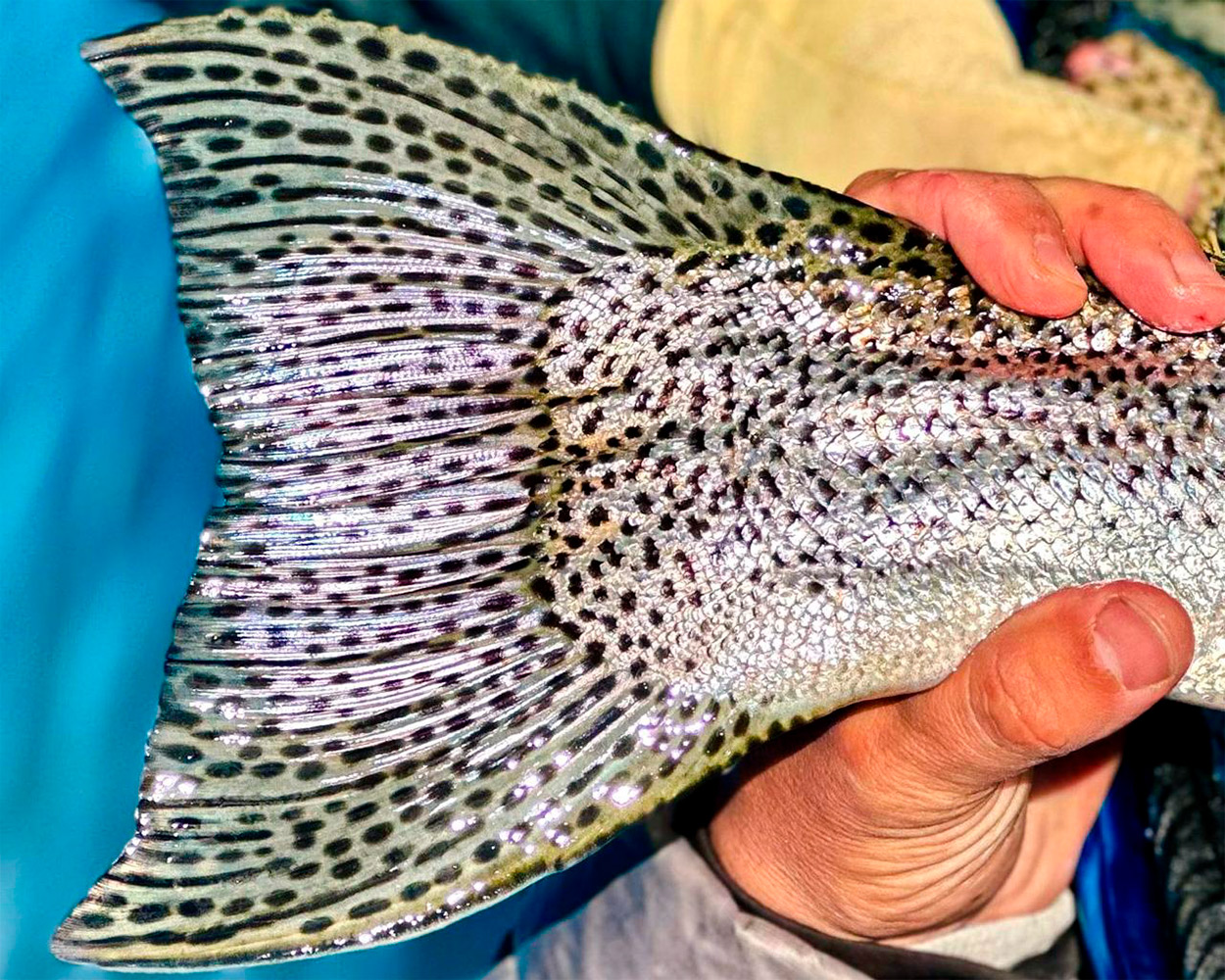
Río Gallegos and Jurassic Lake are two of the most distinctive trout fisheries in southern Patagonia, yet they deliver very different fishing experiences.
One is a long Patagonian river connected to the Atlantic, famous for migratory sea-run brown trout.
The other is a remote lake system on the Santa Cruz plateau, internationally known for large, powerful rainbow trout.
Both can produce remarkable fish. Both demand preparation. Both expose anglers to Patagonia’s wind and open landscapes.
But choosing between them is less about deciding which destination is “better” and more about understanding what kind of fishing you actually want.
The basic difference
The comparison begins with the fish.
Río Gallegos
Primary target: Sea-run brown trout
These are brown trout that migrate between freshwater and the Atlantic. Anglers intercept them after they return to the river.
The experience revolves around:
- river pools
- migratory fish
- swinging flies
- changing depth and current
- reading holding water
- patient, methodical coverage
Jurassic Lake
Primary target: Rainbow trout
Jurassic Lake, also known as Lago Strobel, is famous for exceptionally strong rainbow trout living in a productive stillwater environment.
Fishing may involve:
- shoreline structure
- wind lanes
- drop-offs
- cruising fish
- nymphs and streamers
- visual opportunities under the right conditions
One fishery is shaped by river current and migration.
The other is shaped by a large lake, shoreline structure, food availability, and the movement of powerful resident rainbows.
Río Gallegos is about reading moving water
Fishing the Río Gallegos requires understanding how a large river changes from one section to another.
A guide may consider:
- water level
- current speed
- pool depth
- wind direction
- clarity
- light
- likely resting lanes
The angler then works through the water systematically.
That may mean beginning with shorter casts, gradually extending line, changing the angle of the swing, adjusting depth, and moving step by step through the pool.
Often, the fish is never visible before the take.
You are fishing the water rather than casting to a trout you can see.
That uncertainty is a major part of the appeal.
Jurassic Lake requires learning stillwater
At Jurassic Lake, current is no longer the dominant reference point.
The angler starts thinking about different questions.
Where is the wind pushing food?
Where does the shoreline drop into deeper water?
Are fish cruising close to shore?
Is a particular bay protected or exposed?
Where is wave action creating a feeding opportunity?
For someone who normally fishes rivers, this can require a mental adjustment.
A feature that looks insignificant on land may become extremely important underwater.
The lake can also surprise first-time visitors because large trout may move much closer to shore than expected.
Maximum distance is not always the answer.
Sea-run browns and Jurassic Lake rainbows fight differently
Both species can test tackle, but they tend to create different fights.
Sea-run brown trout often use their body weight and the river current together. A strong fish can move downstream, hold deep, or use the current to make recovery difficult.
Jurassic Lake rainbows have a reputation for speed and explosive energy.
They may produce:
- fast runs
- sudden direction changes
- powerful acceleration
- aerial fights
The contrast is noticeable.
A Río Gallegos brown may feel heavy and determined.
A large Strobel rainbow can feel almost electric.
Neither style is necessarily more exciting. They simply reward different expectations.
The pace of the fishing is different
Río Gallegos fishing frequently rewards patience.
An angler may work carefully through excellent water without immediate action. A day may revolve around a relatively small number of meaningful chances.
That makes concentration important.
The next swing may matter even if the previous twenty produced nothing.
Jurassic Lake can feel more active under good conditions, particularly when trout are moving along productive shoreline or feeding aggressively.
That does not mean constant action is guaranteed.
Wind, temperature, light, and fish movement still affect the lake.
But psychologically, the two fisheries can feel different.
Río Gallegos often asks the angler to trust the water.
Jurassic Lake may offer more opportunities to react to visible or active fish.
Fly selection reflects the environment
Río Gallegos fly boxes commonly emphasize patterns that can be swung effectively through river water.
Useful categories include:
- rubber-leg nymphs
- Woolly Buggers
- leech-style patterns
- dark streamers
- larger silhouettes for reduced visibility
Weight and depth can matter as much as color.
At Jurassic Lake, anglers may also use nymphs and streamers, but the presentation is adapted to stillwater.
The important questions become:
- how quickly the fly sinks
- how it moves during retrieval
- whether fish are cruising near shore
- where in the water column they are feeding
The species may both be trout, but the fly is being asked to solve a different problem.
Wind matters at both destinations
There is no avoiding the subject.
Southern Patagonia can be windy.
On the Río Gallegos, wind affects:
- casting direction
- line control
- bank selection
- swing speed
- positioning
At Jurassic Lake, it can additionally influence:
- wave action
- food concentration
- productive shoreline
- water clarity close to shore
This means wind should not automatically be interpreted as bad fishing weather.
It becomes another variable that guides and anglers learn to use.
Preparation helps enormously at either destination.
An angler comfortable casting in wind will enjoy both fisheries more.
Which destination requires more technical casting?
That depends on conditions and the individual angler.
The Río Gallegos may require controlled longer casts and effective line management through moving water.
Jurassic Lake may ask the angler to deliver flies accurately in strong wind and sometimes control heavier or more wind-resistant setups.
Neither destination requires tournament-level casting ability.
But both reward anglers who can:
- cast efficiently
- maintain control in wind
- adjust trajectory
- avoid unnecessary false casting
- repeat a good presentation
Practicing before traveling has more value than arriving with expensive new equipment and poor control.
The landscapes feel different too
The Río Gallegos moves through the broad Patagonian steppe.
The experience is linear: pools, bends, banks, channels, and changing river sections.
Jurassic Lake feels more exposed and expansive.
The horizon can seem enormous, with water stretching across the plateau and very little visual shelter.
Both are unmistakably Patagonia, but they create different sensations.
The river gives the angler a route to follow.
The lake creates a much wider visual field.
Choose Río Gallegos if…
Río Gallegos may suit you better if you are drawn to:
- sea-run brown trout
- migratory fish
- swinging flies
- reading pools and current
- methodical fishing
- fewer but potentially significant opportunities
- large river environments
- learning how trout use moving water
It is particularly appealing to anglers fascinated by the sea-run life cycle itself.
The fact that the trout has returned from the Atlantic is part of the reason for being there.
Choose Jurassic Lake if…
Jurassic Lake may be the stronger choice if you want:
- large rainbow trout
- powerful, fast fights
- stillwater fishing
- shoreline tactics
- a fishery very different from a traditional river
- a combination of nymphs and streamers
- more emphasis on rainbow trout behavior
It can also appeal to anglers who have already experienced major river fisheries and want Patagonia to show them something different.
Why choose at all?
For international anglers traveling a long distance to southern Argentina, the more interesting question may be whether both fisheries can fit into the same journey.
They complement each other unusually well.
A combined trip can provide:
Río Gallegos
Sea-run brown trout, river pools, migratory behavior, swung presentations.
Then:
Jurassic Lake
Rainbow trout, stillwater, shoreline fishing, different presentations.
You are not simply changing locations.
You are changing species, habitat, technique, and rhythm.
That is exactly what makes the combination attractive.
Karku can incorporate Jurassic Lake into a custom Combo Trip when dates, availability, and logistics align.
Which should come first?
There is no universal rule.
Some anglers prefer beginning with the Río Gallegos while energy and concentration are highest, then shifting to a different fishing style at Jurassic Lake.
Others may prefer the opposite.
The decision should depend on:
- available dates
- travel logistics
- fishing season
- lodge availability
- total trip length
The objective should be the cleanest itinerary rather than forcing a specific order.
Final thoughts
Río Gallegos and Jurassic Lake represent two very different sides of Patagonia trout fishing.
Choose the Río Gallegos if the idea of a sea-run brown trout returning from the Atlantic is what brings you south.
Choose Jurassic Lake if your priority is powerful rainbow trout in one of Patagonia’s most unusual stillwater environments.
Choose both if you want the contrast.
River and lake.
Brown and rainbow.
Migration and residency.
Swinging water and working shoreline.
For anglers planning a Río Gallegos week with Karku Fly Fishing Lodge, Jurassic Lake can be considered as a custom extension when timing and availability make the combination practical.
Contact Karku to discuss whether a Río Gallegos and Jurassic Lake itinerary fits your dates, travel schedule, and fishing priorities.