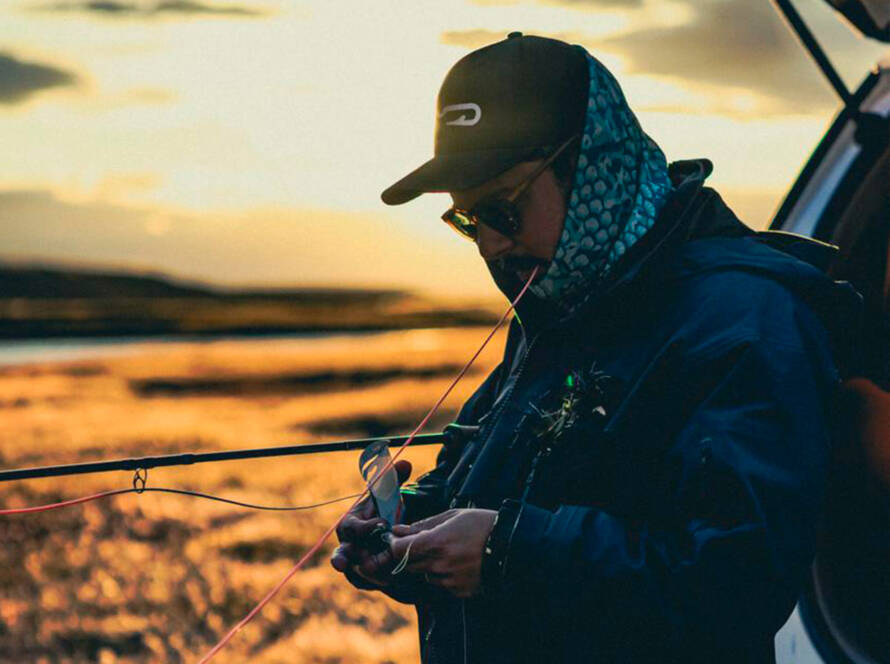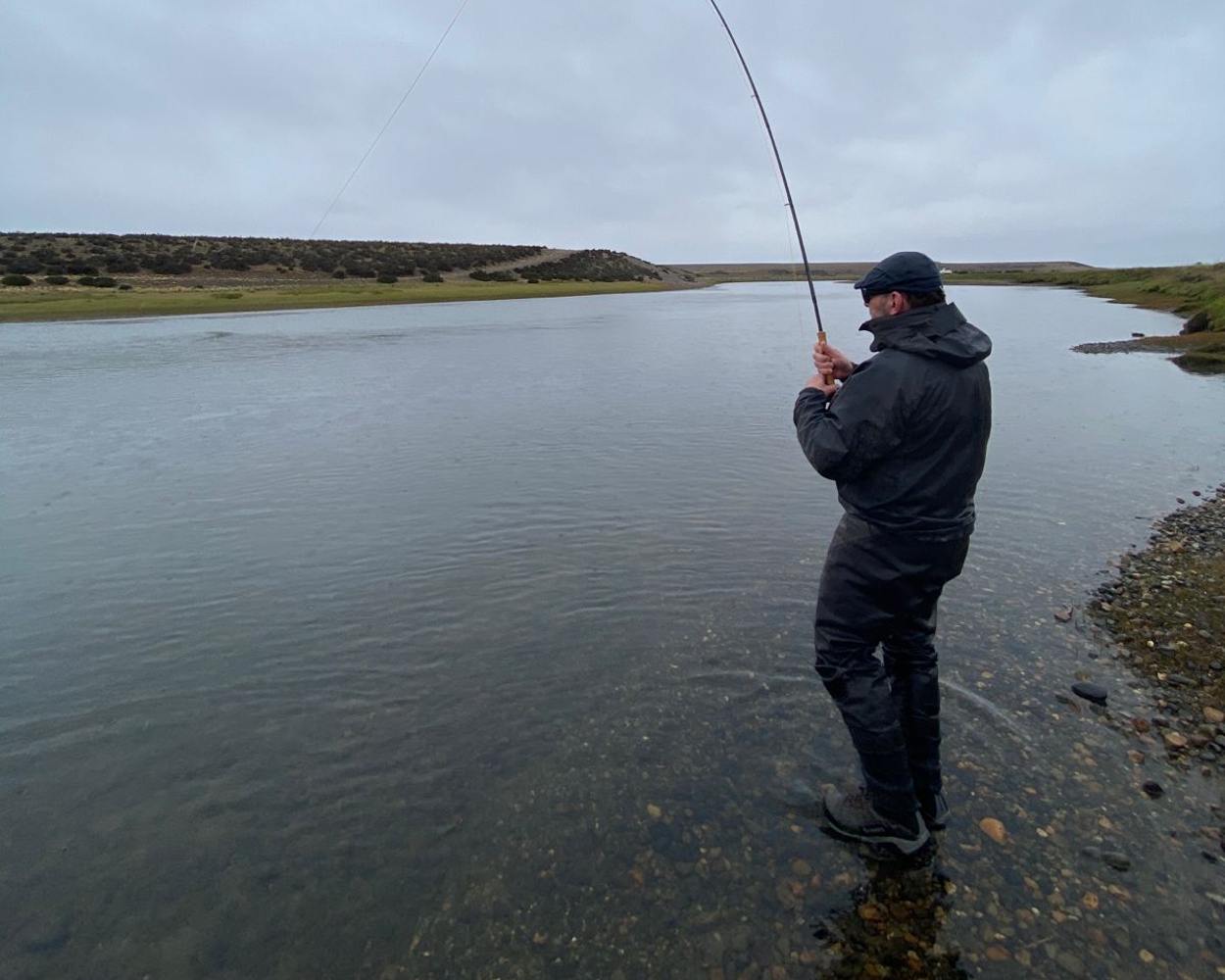
Santa Cruz is one of the most varied fly fishing regions in southern Patagonia.
Within the same Argentine province, an angler can target sea-run brown trout on the Río Gallegos, powerful rainbow trout at Lago Strobel, steelhead on the Río Santa Cruz, and brook trout in smaller southern waters.
The geography changes just as dramatically.
Atlantic coastline gives way to open steppe, volcanic plateaus, enormous lakes, glacial landscapes, and the Andes along the Chilean border.
For visiting anglers, this creates an important advantage: Santa Cruz can support several very different fishing experiences without requiring a journey across the entire length of Patagonia.
The key is understanding where each fishery sits and what kind of trip it offers.
Río Gallegos: the sea-run brown trout fishery
For anglers interested in migratory brown trout, the Río Gallegos is one of Santa Cruz’s defining rivers.
The river crosses the southern Patagonian steppe before reaching the Atlantic. Brown trout that adopt a sea-run life cycle use that connection, returning from saltwater into freshwater.
The provincial tourism authority specifically identifies the Río Gallegos with migratory sea-run brown trout and describes a fishing season extending broadly from November into April. Santa Cruz Patagonia
Fishing here centers on reading moving water.
Guides pay attention to:
- pools and current transitions
- river level
- depth
- water clarity
- wind direction
- light
- likely travel and resting lanes
The angler frequently, but not always, fishes water without seeing the trout first.
That makes Río Gallegos very different from a sight-fishing or hatch-driven trout river. Patience, controlled presentation, and confidence in the pool become important parts of the experience.
Karku is based in this southern Santa Cruz fishery, making the Río Gallegos the natural starting point for anglers whose principal objective is sea-run brown trout.
Lago Strobel: the giant rainbow trout side of Santa Cruz
Travel north into the Santa Cruz plateau and the fishing changes completely.
Lago Strobel, internationally known as Jurassic Lake, has become one of Patagonia’s signature rainbow trout destinations. The provincial tourism authority identifies the lake as one of Santa Cruz’s major sport-fishing environments. Santa Cruz Patagonia
This is primarily stillwater fishing.
Instead of analyzing river current, anglers begin thinking about:
- shoreline structure
- wind direction
- drop-offs
- cruising lanes
- wave action
- feeding depth
Large rainbows and an exposed plateau environment give Strobel a completely different character from the Río Gallegos.
That contrast also explains why the two can work particularly well in the same longer itinerary.
One fishery is built around migratory brown trout moving through a river.
The other revolves around powerful resident rainbows in a vast lake system.
Río Santa Cruz: a steelhead option
The Río Santa Cruz adds another migratory salmonid to the province.
Near Comandante Luis Piedra Buena, the river is known for steelhead—sea-run rainbow trout—and provincial tourism information identifies it as one of Santa Cruz’s distinctive sport-fishing opportunities. Santa Cruz Patagonia
This is large water.
For an angler already interested in migratory fish, it provides an interesting comparison with the Río Gallegos:
Río Gallegos: sea-run brown trout.
Río Santa Cruz: sea-run rainbow trout, or steelhead.
Both require patience and an understanding of moving fish, but they are not interchangeable experiences.
For anglers traveling a long distance to southern Argentina, this gives Santa Cruz an unusual advantage: several major migratory trout fisheries exist within the same province.
Río Coig and smaller-water brook trout
Santa Cruz is not only about large rivers and giant fish.
The Río Coig/Coyle area and associated smaller waters offer another scale of fishing, including brook trout (Salvelinus fontinalis). Provincial fishing information specifically lists brook trout in the Río Coig, Río Pelque, and Arroyo Italiano systems. Santa Cruz Patagonia
The experience can involve:
- lighter tackle
- shorter casts
- smaller runs
- dry flies
- accurate presentation
- more intimate water
That creates an interesting contrast with a Río Gallegos week.
After spending several days covering large pools for migratory brown trout, an angler can move into smaller water where precision becomes more important than distance.
The appeal is not necessarily maximum size.
It is a different expression of Patagonia trout fishing.
Santa Cruz is a province of contrasts
The strongest reason to understand Santa Cruz as a fishing destination is the diversity packed into one region.
An angler can move between:
Sea-run brown trout
Río Gallegos.
Rainbow trout
Lago Strobel
Steelhead
Río Santa Cruz.
Brook trout
Smaller southern rivers and tributaries.
That means a multi-species trip does not have to repeat the same fishing style with a different name attached to the fish.
Each environment changes the problem the angler needs to solve.
The landscape changes with the fishing
Santa Cruz also makes sense for anglers who want the travel itself to feel varied.
Around Río Gallegos, the dominant landscape is open steppe and Atlantic-influenced southern Patagonia. The city and its estuary also provide access to wildlife, birdlife, estancia country, and nearby coastal environments. Santa Cruz Patagonia
Farther west, the province eventually reaches the Andes and the glacial landscapes around El Calafate and El Chaltén.
This creates an opportunity to combine fishing with other parts of a Patagonia journey without immediately moving into another region of Argentina.
A trip can therefore have distinct stages:
Río Gallegos: fishing.
Central Santa Cruz: additional fisheries or the Strobel plateau.
Western Santa Cruz: glaciers, mountains, hiking, and broader tourism.
That is especially useful when traveling with a non-angling partner.
Distances still need to be respected
The fact that these destinations share one province does not mean they are close together.
Santa Cruz is large, sparsely populated, and travel times can be significant.
A good itinerary should therefore avoid trying to collect destinations simply because they appear on the same map.
Instead, decide which experience has priority.
If the Río Gallegos is the reason for traveling, protect that fishing week first.
Then determine whether the available time supports:
- another fishery
- nearby activities around Río Gallegos
- El Calafate
- El Chaltén
- a Chilean extension
Adding one strong extension usually creates a better trip than trying to fit four distant destinations into too few days.
Río Gallegos is also a practical southern gateway
Río Gallegos is the provincial capital and a major service center for southern Santa Cruz. Provincial tourism information highlights its estuary, wildlife, museums, nearby estancia experiences, and access toward Cabo Vírgenes and the beginning of Ruta 40. Santa Cruz Patagonia
For anglers, this matters because the fishing trip does not exist in isolation.
Extra time can be used for local exploration before committing to a much longer extension.
That may include:
- the Río Gallegos estuary
- Laguna Azul
- Cabo Vírgenes
- estancia country
- wildlife and birdwatching
These options make particular sense when a traveler has only one or two additional days.
Regulations are specific to the water
Another important point: Santa Cruz is not one fishing zone with one universal set of rules.
Licenses, seasons, fishing methods, and individual water regulations should be confirmed for the exact destination being fished.
Argentina’s national parks guidance notes that Patagonia fishing generally operates under specific seasonal and water-by-water regulations and requires the corresponding fishing permit. Argentina
A lodge or qualified operator should provide current information before the trip.
This is especially important when combining multiple fisheries.
Who is Santa Cruz best suited to?
Santa Cruz is particularly compelling for anglers who want one of three things.
A focused sea-run brown trout trip
Choose Río Gallegos and dedicate the week to learning one major river properly.
A multi-species fishing journey
Combine contrasting fisheries such as Río Gallegos and Jurassic Lake rather than simply adding another similar river.
Fishing plus a broader Patagonia trip
Build the fishing around Río Gallegos, then use additional time for the Atlantic coast, El Calafate, El Chaltén, or another southern extension.
The province works because those choices can remain connected geographically without pretending that every destination is nearby.
Final thoughts
Santa Cruz Province offers much more to a fly angler than one famous river.
The Río Gallegos delivers sea-run brown trout.
Lago Strobel provides an entirely different rainbow trout experience.
The Río Santa Cruz adds steelhead.
Smaller southern systems offer brook trout and lighter fishing.
Beyond the water, the landscape shifts from Atlantic steppe to volcanic plateau and eventually to the Andes and glaciers.
That variety makes Santa Cruz especially valuable for international anglers who want a Patagonia trip with a clear fishing objective but enough diversity to justify traveling so far.
For anglers who want the Río Gallegos and its sea-run brown trout to remain at the center of the journey, Karku Fly Fishing Lodge provides a focused southern Santa Cruz base from which the rest of the trip can be planned around the time, species, and experiences that matter most.
Contact Karku to discuss current fishing dates, Río Gallegos availability, and possible additions to a longer Santa Cruz itinerary.